

AI-Generated Personalized Children's Books
An original story and original illustrations, generated end-to-end for one specific child — printed and shipped as a real 32-page book. The honest version of an AI personalized children's book.
How the AI Actually Builds Your Child's Book
- Story written by Claude Sonnet: Large language model from Anthropic. Calibrated by reading level (four options) and your prompt. You edit and approve before illustration begins.
- Illustrations by Gemini 3 Pro Image: Google's latest image model, specifically chosen because it can hold character likeness across multiple generations — the technical hard part of an AI storybook.
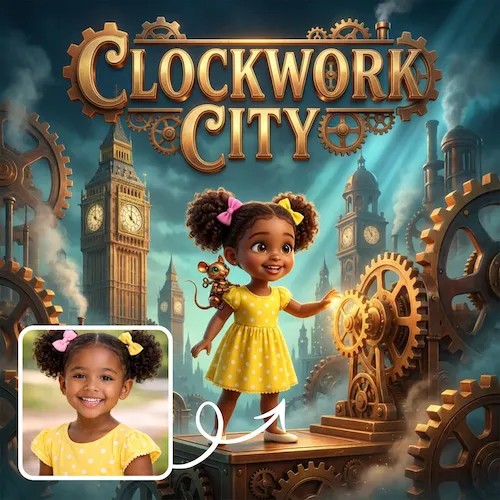
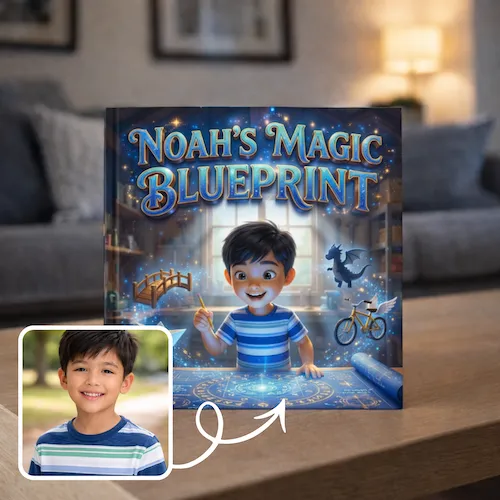
- Photo to character, not photo to clip art: A vision model analyzes the uploaded photo and builds a character description the image model uses as a constraint on every illustration.
- You approve before each phase moves forward: Story text first, then characters, then pages. You can rewrite, regenerate, or change direction at every step.
- Human review before printing: Every book is read end-to-end and visually inspected by a real person before going to print. No exceptions, no skipped reviews.
The book is built in four phases. Each phase uses a different AI model with its own validation step before the next phase starts. We do it this way because the alternative — one model generating everything at once — produces stories that drift, illustrations that do not match the text, and characters that look different from page to page.
Phase one is story generation. We send your prompt, your character names and ages, and your chosen reading level to a large language model (currently Claude Sonnet from Anthropic). It produces a full 13-page story, page by page, with vocabulary and sentence length calibrated to the age you picked. You read it, edit anything you want, and approve before anything else happens.
Phase two is character analysis. We send your uploaded photos to a vision-capable AI (Gemini 3 Pro from Google). It identifies each face, builds a structured description of features that should stay consistent — hair, skin tone, glasses, expression — and pulls out any "props" the story will need (a soccer ball, a particular pet, a favorite stuffed animal).
Phase three is illustration. For each character and each page, we use Gemini 3 Pro Image (also known as Nano Banana Pro) to generate the artwork using the character description as a constraint. This is the part that makes the same kid look like the same kid across 13 different scenes — a problem most AI image tools cannot solve on their own. You preview characters before paying, then approve every page after.
Phase four is human review. Before any book ships, a real person on our team reads the full draft, looks at every illustration, and catches anything that is awkward, off-tone, or just wrong. That review step is the reason we are comfortable charging for the result. AI handles the heavy lifting; humans handle the last few percent that AI still gets wrong.
What the AI Is Good At — and What Human Review Catches
- AI strength — speed: A bespoke 32-page personalized storybook in about 15 minutes of your time.
- AI strength — consistency: The same character, recognizably the same, across every illustrated page of the book.
- AI strength — originality: Every story is generated from scratch. No two orders produce the same book.
- Human strength — anatomy and tone: Subtle anatomy quirks — an extra finger, an odd hand pose, a faint facial asymmetry — that AI image models occasionally produce and that parents reviewing their own child's book often miss because their attention is on the face. Plus tone, pacing, and the subtle off-ness that AI still does not reliably catch. Our reviewer catches them before printing.
- You stay in control: You can override or regenerate anything the AI produces. The book is yours to shape, not just yours to receive.
Being honest about AI in 2026 means being honest about both sides. The AI we use is genuinely good at certain things: building a coherent story to your prompt at the reading level you pick, holding character likeness across illustrations, generating original art in a style you choose, and doing all of this in about 15 minutes of interactive work. It is not yet good at certain other things, which is why every order has a human review step before printing.
Things the AI handles reliably. Generating an age-appropriate story arc with beginning, middle, and end. Maintaining character names and relationships across pages. Drawing the same kid recognizably across 13 illustrations. Adjusting vocabulary to a specified reading level. Producing distinct, stylistically consistent artwork in seven different art styles.
Things human review catches. Subtle anatomy quirks — a sixth finger, a hand at an odd angle, a face with a faint asymmetry — that AI image models still produce occasionally. These are also the things parents most often miss when reviewing their own child's book, because attention naturally goes to whether the face looks like the kid rather than to the hands holding the soccer ball. Subtle tone problems (a sentence that reads fine in isolation but lands strangely in context). Background details in illustrations that do not quite match the text. Pacing issues where a page has more text than the illustration can support. Anything where the result is technically "correct" but does not feel like a finished children's book.
The result is a book where the AI does what AI is best at — speed, originality, personalization at scale — and a human does what humans are still best at: catching the things that just do not feel right.
How It Works
From a single photo to a professionally printed book — 6 steps, about 15 minutes of your time.
Upload photos
Pick your style
Approve every page
Printed & shipped
How This Compares to Other AI Storybook Approaches
There are now several ways to make an "AI personalized children's book," and they differ a lot in quality, control, and effort. Worth knowing the landscape before you pick one.
The roll-your-own approach. Combining ChatGPT (or Claude) for the story and Midjourney (or DALL-E) for the illustrations is technically possible, costs almost nothing, and is what a lot of curious parents try first. The problem you hit fast is character consistency — the kid you generated on page 1 does not look like the same kid on page 5, because the image model has no way to remember. Story-illustration alignment also wanders. The result is fun to play with but rarely something you would print and hand over as a gift.
Name-swap personalized books. Several mainstream personalized-book services use a fixed story and substitute the child's name (and sometimes appearance variables). These are technically not AI-generated — they are templates with variables. The story and illustrations are professionally made, and the format works well as a one-time gift. The trade-off is that ordering a second book for a sibling later means the same underlying story with different names.
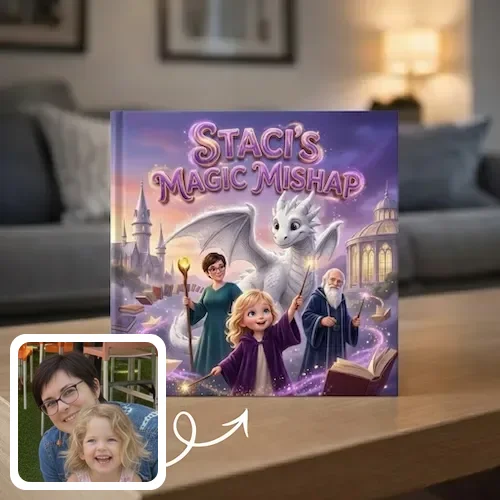
AI-illustrated personalized books — the category we are in. Each book is generated from scratch around your inputs, but with a structured pipeline (and human review) that solves the consistency problem you hit on the roll-your-own path. The trade-off is honest: it costs more than a name-swap book and takes longer than a ChatGPT experiment, but the result is something you can put on the shelf without apologizing for.
None of these categories are wrong. Pick the one that fits the use case. If you want fast and cheap, name-swap is reasonable. If you want technical curiosity and do not mind quality variance, roll your own with raw AI tools. If you want a finished, printable children's book with your kid in it, the third category is what most parents are picturing when they imagine an AI-personalized storybook.

How the Book Is Built
- 32 printed pages, 7.5" × 7.5": Paperback or hardcover, professionally printed and shipped in 7–10 business days after final approval.
- 4 reading levels, 7 art styles: Mix and match. The same child can have a Toddler-level Magical Cartoon book this year and a Young Storyteller Watercolor next year.
- Up to 4 characters: Kids, parents, grandparents, pets, or any mix. Photo per person.
- 20 regenerations included: Refine any illustration after purchase. Extra regenerations available if you want to fine-tune further.
- Digital flipbook and printable PDF included: Ready the moment you approve the book. Useful for gifts on a tight deadline or for sharing on a video call.
Every book is the same physical format: 32 pages total, 7.5" × 7.5" square. 13 illustrated story pages alternate with 13 pages of text. Plus a dedication page, title page, and a few internal front- and back-matter pages.
Reading level: pick one of four (3–5, 5–7, 7–10, 11+). Art style: pick one of seven, including Magical Cartoon, Retro Adventure, 3D Rendered, and Watercolor. Characters: up to 4 per book (kids, parents, grandparents, pets, or any mix).
Every order includes the printed book — paperback (35), hardcover (50), or both as the Keepsake Bundle. Plus a digital flipbook viewable in any browser. Plus a printable PDF. Plus 20 image regenerations to refine the artwork after purchase. Plus the human review pass before printing. Plus a 7-day replacement guarantee on damaged or misprinted books.
What families are saying
A few public Trustpilot reviews from families who have ordered Genie in a Book.
“I loved Genie in a Book and being able to see all of the great storytelling that this tool provides.”
Patrick
via Trustpilot
“Genie in a Book made my dreams come true. I always wanted to create a book about me and my little host kid, and now I have it.”
Simona S.
via Trustpilot
“I've received the book and am delighted with the quality, the layout and the print.”
Victor G.
via Trustpilot
Questions parents ask about the AI
The honest answers to what most people actually want to know about an AI-personalized children's book.
You Might Also Like
See what AI can create just for your family
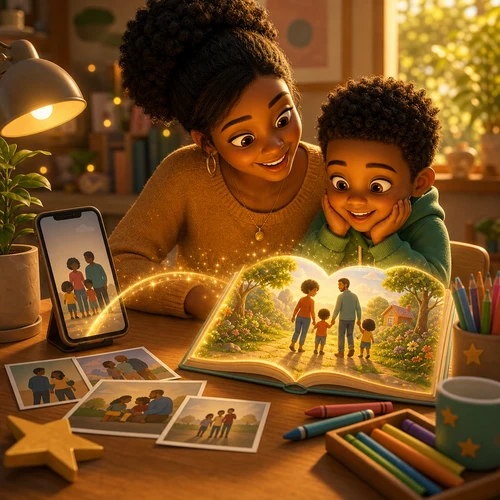
Upload a photo, describe the adventure, and our AI will write and illustrate a completely original book starring your child — generated end-to-end, human-reviewed, and printed.
Takes about 15 minutes · Truly unique every time · Human-reviewed before printing